
I’ve been teaching Pilates for over 30 years, and one of the first things I say to every new teacher in my training program is this: there’s a difference between an instructor and a teacher. It sounds like a small distinction, but it shows up big in your results.
An instructor gives instructions. They tell you what to do, when to do it, and how many times. That’s important because clear instruction matters … but a teacher does something different. A teacher facilitates experiences. They help the student discover something for themselves – which is the most direct path to learning. In a movement practice like Pilates, being skilled at helping students make connections is what makes a teacher extraordinary.
I talk about this a lot, especially now — when Pilates content is everywhere and it’s easy to confuse performing Pilates with teaching it. So many teachers now are only interested in showing the coolest or most athletic movements. They pack their sessions with fun, new exercises to try… But is this really teaching the system of Pilates?
Instruction Is a Transfer. Teaching Is a Transformation.
When I instruct, I’m sending information from me to you. “Inhale. Reach your arms. Roll up.” Done. Information transferred.
But when I teach, I’m helping you build understanding in your own body. I’m watching how you move. I’m asking what you feel. I’m noticing when my cue landed and when it didn’t … and making adjustments. The success of a teaching moment isn’t measured by whether I said the right thing. It’s measured by whether you got it – whether you were able to turn my words into your movement.
This matters in Pilates more than almost any other fitness discipline, because Pilates is a skills-based practice. You’re not just performing movements — you’re developing body awareness, coordination, and neuromuscular control. That kind of learning can’t be instructed into someone. It has to be experienced.
The Science Behind Why This Matters
There’s a model I present in my “Exceptional Teaching Skills” module called the Cone of Learning, developed by educator Edgar Dale. It’s an old model that’s been debated in academic circles (*see articles), but I’ve found it still holds up in practice, especially for teaching movement skills.
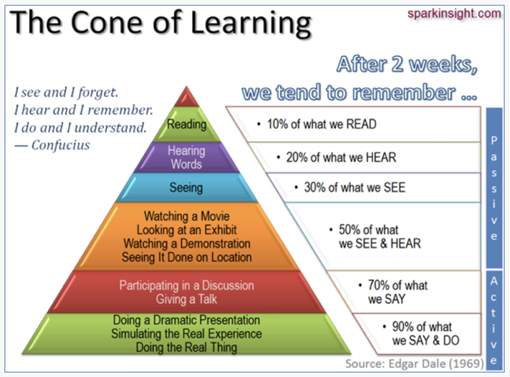
The basic idea: people retain roughly 10% of what they read, 20% of what they hear, and 30% of what they see. But they retain about 80% of what they actually do and 90% of what they do and say simultaneously.
So the design and delivery of your session determines how much your client actually learns. If clients are actively doing, noticing, and being asked to articulate what they’re feeling — learning increases. When they experience those sensations repeatedly, they begin to make their own connections. A good teacher will help create opportunities and guide a student to those moments.
Here’s an even bigger takeaway for learning, and the number that always surprises people: People retain about 95% of what they teach to others. This is exactly why every serious Pilates teacher training program is built on an apprentice model – why most programs have built-in hundreds of hours of observation and practice teaching. You don’t learn to teach Pilates by watching someone teach Pilates. You learn it by teaching it – on real bodies, in real studios.
What Exceptional Teaching Actually Looks Like
I want to get concrete here, because “facilitate learning” can be abstract. Here’s what it looks like in practice.
You assess constantly. An exceptional teacher is always watching — not just whether the client is doing the exercise, but whether they understood the cue, whether the cue is even working, and what to try next if it isn’t. I once heard Rael Isacowitz, founder of BASI Pilates, say: “Don’t beat a dead cue.” If it’s not landing, move on.
You ask instead of tell. There’s a big difference between asking “Do you feel your abs?” and asking “What do you feel?” One is a yes/no check. The other invites the client to dive into their own proprioceptive awareness — to actually notice what’s happening in their body, regardless if it’s the thing we want them to feel. Awareness of any sensation is positive – That’s the skill we’re building.
You know when not to cue. This is one I see newer teachers struggle with. If a client has something, you don’t need to state it. Also, if they don’t get it on the first try… give it a minute. Let them discover something. Unnecessary cueing creates noise and actually interrupts the learning. Part of teaching well is recognizing when to get out of the way.
You let them make mistakes. This feels counterintuitive, but it’s one of the most powerful teaching tools available. Having a client safely experience what an exercise feels like when it’s done incorrectly — and then feel the difference when it’s done right — builds understanding in the body that no amount of verbal instruction can replicate.
You make connections. A great Pilates teacher helps clients see the thread running through the work — How the shape of one exercise mirrors the shape of another, how the mat exercise connects to the apparatus, how the essential movement shows up in the advanced variation, and how what they’re practicing in the session serves them outside the studio.
We Are Only Successful If Our Clients Are Successful
That’s the standard I hold myself to, and the one I teach to every teacher who comes through my program. Not: did I deliver a good session or did we get to do a bunch of advanced exercises? But: did my client leave feeling different than they arrived? Do they understand more about their own body than they did an hour ago? I feel most successful when a client comes to me and says “I thought of you when I was picking up my groceries” or “This exercise is just like teaser!”
What works for one client may not work for another. People have different learning styles — some are visual, some are auditory, some respond to imagery, and some need to feel it in their body before any instruction makes sense. An instructor delivers the same session to everyone… but a teacher reads the room and adjusts to the people in it.
That adaptability is a skill. Like any skill in Pilates, it takes time, practice, and real training to develop. It doesn’t come from watching enough classes or collecting enough CECs. It comes from doing the deep work of knowing the Pilates system, learning how people learn — and then practicing it, getting feedback, and refining.
Are You Ready to Go From Good to Exceptional?
This is exactly the work we do in the M2Btt teacher training program. As part of our comprehensive Teaching Training Program, we have an entire 3 day module called “Exceptional Teaching Skills” where we go deep on learning styles, cueing technique, how to read a client in real time, and how to create actual transformation — not just good workouts.
It’s also directly relevant to anyone preparing for the NCPT exam through the National Pilates Certification Program. You are required to obtain a minimum 450 hour certification including apprentice hours before you can sit for the NPCP exam – the standard I helped develop, and the one that defines what it means to be a highly credentialed Pilates professional.
If you’re interested in becoming an exceptional teacher or want to bring your skills to a higher level, reach out to learn more about the M2Btt program and our CEC Workshops delivered virtually, or at our beautiful studio in Providence, Rhode Island, USA.